

How Home Service Contractors Can Dominate Video Search Results
Video content now dominates search results across Google, YouTube, and social media platforms. When potential customers search for “how to fix a leaky faucet” or “signs you need a new HVAC system,” video results frequently occupy the top positions. For home service contractors, this shift represents both a challenge and an enormous opportunity.
Most local businesses either ignore video entirely or create content without any optimization strategy. They upload videos to YouTube, add a basic title, and wonder why nobody watches. Meanwhile, contractors who understand video SEO local business strategies capture qualified leads actively searching for solutions to problems only professionals can solve.
Video SEO extends far beyond YouTube. Google increasingly displays video carousels in search results for local service queries. Voice assistants recommend video tutorials when users ask how-to questions. AI platforms like ChatGPT and Perplexity link to video content that demonstrates expertise. Optimizing your video content for these multiple platforms multiplies your visibility across every channel where potential customers search.
Why Video SEO Matters for Home Service Companies
Search engines treat video content fundamentally differently than text. A well-optimized 3-minute video can outrank comprehensive written articles because search algorithms recognize that users prefer visual demonstrations for many topics. When someone searches “how to bleed a radiator,” they want to see the process, not read about it.
Key advantages video provides for local contractors:
- Videos appear in both regular search results and dedicated video carousels
- YouTube serves as the second-largest search engine after Google
- Video content keeps potential customers on your website longer, signaling quality to search engines
- Visual demonstrations establish expertise more convincingly than written descriptions
- Mobile users overwhelmingly prefer video content over text
- Videos generate backlinks naturally as other sites embed your content
- Google’s AI systems increasingly pull video content into featured snippets
The Redshift Local VTC Framework applies directly to video strategy. Visibility comes from appearing in video search results across multiple platforms. Traffic flows when viewers click through to your website or contact information. Conversions happen because video builds trust faster than any other content format.
Local service businesses benefit particularly from video because your services require visual explanation. Homeowners struggling with a broken water heater want to see what the problem looks like and understand whether they need emergency service. Video lets you demonstrate expertise while pre-qualifying leads who understand your value before they call.
Creating Videos That Rank and Convert
Video SEO local business success starts with content strategy, not production quality. You don’t need expensive equipment or professional editing. Smartphone cameras shoot perfectly adequate footage for most contractor videos. Focus instead on topics that address specific search queries your potential customers actually use.
High-performing video topics for home service contractors:
- Common problem diagnosis (“Why is my AC blowing warm air?”)
- Seasonal maintenance tutorials (“Preparing your furnace for winter”)
- Cost expectation videos (“How much does water heater replacement cost?”)
- Emergency vs. non-emergency situations (“When you need an emergency plumber”)
- Before and after project showcases with explanations
- Equipment comparison guides (brands, efficiency ratings, features)
- Red flag warnings about DIY attempts gone wrong
- Local code requirements and permit explanations
Each video should target a specific search query. Research what questions homeowners ask using Google’s autocomplete, Answer the Public, or the “People Also Ask” section in search results. Create videos that directly answer these questions in 3-8 minutes.
Short-form videos work differently than long-form content. For YouTube Shorts, TikTok, or Instagram Reels, focus on single quick tips or dramatic problem reveals. These build brand awareness and can rank for specific queries, but longer videos demonstrate expertise more thoroughly and rank for broader search terms.
Optimizing Video Titles and Descriptions
The title represents your most critical optimization element. Search engines cannot watch your video, so they rely heavily on titles to understand content. Your title must include your target keyword naturally while being compelling enough that users want to click.
Title optimization strategies:
- Place primary keyword within the first 5 words when possible
- Include location for local searches (“Pittsburgh HVAC maintenance tips”)
- Use numbers and specifics (“5 signs you need emergency electrical repair”)
- Keep titles under 60 characters to avoid truncation in search results
- Front-load important information rather than using clever wordplay
- Include year for evergreen content that should be seen as current
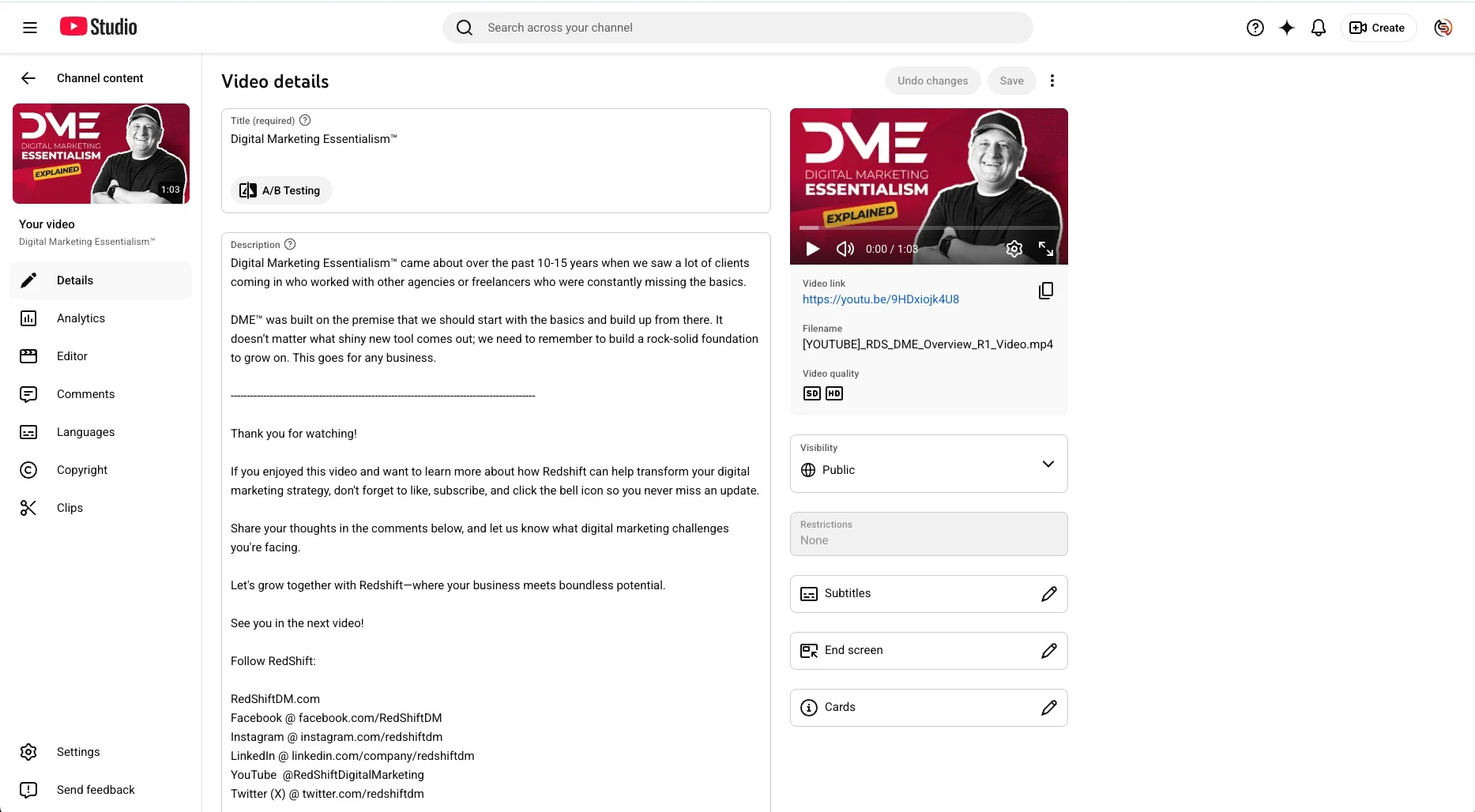
Video descriptions provide extensive space to include keywords, explanations, and links. Many contractors waste this opportunity with one-sentence descriptions. Search engines and AI platforms read your entire description to understand context and relevance.
Write descriptions that include:
- A detailed summary of video content in the first 150 characters (this appears in search results)
- Full transcript or detailed outline of topics covered
- Links to related service pages on your website
- Contact information including phone number and service area
- Timestamps for different sections in longer videos
- Related keywords and variations throughout the description
- Clear call-to-action telling viewers what to do next
Include your business name, location, and service area naturally throughout the description. This helps local SEO while providing context that search algorithms use for ranking decisions.
Leveraging Tags, Chapters, and Metadata
YouTube and Google use multiple data points beyond titles and descriptions. Tags help categorize your content, though they carry less weight than they once did. Focus tags on specific services, locations, and topic variations rather than broad generic terms.
Effective tagging approach:
- Include your primary keyword exactly as targeted
- Add location-specific variations (city name, neighborhoods, region)
- List related services and topics covered in the video
- Use both singular and plural versions of key terms
- Include common misspellings or alternative phrasings
- Add competitor brand names when relevant and appropriate
- Limit to 10-15 highly relevant tags rather than stuffing keywords
Video chapters dramatically improve user experience and SEO performance. Breaking longer videos into timestamped sections helps viewers navigate to specific information. Search engines also pull these timestamps into results, increasing the chance your video appears for multiple related queries.
Add chapters by including timestamps in your description:
0:00 Introduction to furnace maintenance 1:15 Checking and replacing air filters 3:30 Inspecting the flame sensor 5:45 Testing thermostat functionality 7:20 When to call a professional
Google sometimes displays these timestamps directly in search results, giving your video more visual space and multiple entry points for viewers.
Creating Compelling Thumbnails That Drive Clicks
Your thumbnail determines whether users click your video when it appears in search results. Even with perfect optimization, poor thumbnails kill performance. Custom thumbnails should be clear, high-contrast, and convey immediate value.
Thumbnail best practices for contractor videos:
- Use close-up images rather than wide shots (details get lost at small sizes)
- Include faces when possible (human faces dramatically increase click rates)
- Add text overlay highlighting the main benefit or topic
- Use bright, contrasting colors that stand out in search results
- Show the problem or result, not generic stock imagery
- Maintain consistent branding across thumbnails (colors, fonts, logos)
- Test different thumbnail styles and monitor which generate higher click rates
Avoid clickbait thumbnails that misrepresent content. While misleading thumbnails might generate initial clicks, viewers quickly leave when content doesn’t match expectations. This increases bounce rate and signals to search engines that your video lacks relevance, hurting long-term rankings.
Optimizing for Voice Search and AI Platforms
Voice assistants and AI chatbots increasingly reference video content when answering spoken queries. When someone asks Alexa “How do I know if my water heater is failing?”, voice assistants pull answers from highly optimized video content that clearly explains the topic.
Structure videos for voice search by:
- Answering the main question within the first 30 seconds
- Using clear, conversational language rather than technical jargon
- Stating questions explicitly before answering them
- Organizing content in logical sequences that AI can parse
- Including natural transitions between topics
- Speaking directly to camera rather than showing only work footage
AI platforms evaluate video transcripts when determining what content to recommend. YouTube automatically generates transcripts, but automatic transcription contains errors that confuse algorithms. Upload edited transcripts that accurately reflect your content while naturally incorporating additional relevant keywords.
Building Video-Based Local Landing Pages
Videos shouldn’t exist only on YouTube or social media. Embed videos on relevant service pages across your website. This increases time-on-site metrics while providing visual content that helps convert visitors into leads.
Strategic video placement on your website:
- Service pages: Videos explaining specific services you offer
- FAQ pages: Video answers to common customer questions
- Blog posts: Supporting video content that reinforces written information
- Homepage: Brief introduction video establishing expertise and service area
- Testimonial pages: Customer review videos with project walkthroughs
- Location pages: Videos showcasing work completed in specific neighborhoods
Each embedded video should have surrounding text content that includes the video transcript, additional explanation, and relevant internal links. This creates comprehensive landing pages that rank well while offering multiple content formats for different user preferences.
Video schema markup tells search engines explicitly that your page contains video content. This increases the likelihood of appearing in video search results and rich snippets. Add VideoObject schema that includes title, description, thumbnail URL, upload date, and duration.
Promoting Videos Across Multiple Channels
Creating optimized videos represents only the first step. Distribution across multiple platforms multiplies visibility and generates the backlinks and engagement signals that improve search rankings.
Multi-platform video distribution strategy:
- Upload full videos to YouTube as your primary hosting platform
- Create short clips for YouTube Shorts, TikTok, Instagram Reels, and Facebook
- Share videos in relevant Reddit communities where appropriate
- Embed videos in email newsletters to existing customer base
- Post video links in Google Business Profile updates
- Share videos on local Facebook groups and Nextdoor
- Include video links in responses to questions on community forums
Each platform requires slightly different optimization. Instagram prioritizes hashtags while YouTube focuses on descriptions and tags. Adapt your approach to each platform’s unique algorithm without completely recreating content.
Cross-link between videos to build playlists around specific topics. Group all HVAC maintenance videos into one playlist, all emergency repair videos into another. Playlists increase watch time as viewers automatically continue to related videos, signaling to YouTube that your content keeps users engaged.

Measuring Video SEO Performance
Track video performance across multiple metrics to understand what content resonates with your target audience and generates actual business results. Views alone don’t indicate success if those viewers never convert into customers.
Critical video metrics for local contractors:
- Impressions: How often your video appears in search results
- Click-through rate: Percentage of impressions that result in plays
- Watch time: Total minutes viewed across all viewers
- Average view duration: How much of your video people actually watch
- Traffic sources: Where viewers find your videos (search, suggested, external)
- Engagement: Likes, comments, and shares that signal value
- Conversion actions: Website clicks, calls, or contact form submissions
Use UTM parameters on links in video descriptions to track how video traffic behaves on your website. Create unique landing pages or phone numbers for video campaigns to measure conversion rates accurately.
Monitor which videos generate the most phone calls or contact form submissions. These topics represent high-intent searches where viewers have immediate needs. Create additional videos on related topics to capture more traffic in high-converting categories.
Video SEO local business strategies integrate seamlessly with comprehensive marketing approaches like Redshift Local’s VTC Framework. Videos increase visibility across search platforms, drive qualified traffic to your website and contact channels, and convert viewers into customers through demonstrated expertise. Contractors who master video optimization gain sustainable competitive advantages as search engines and AI platforms increasingly prioritize video content in results.