

Local SEO is experiencing its biggest transformation since Google introduced the local pack in 2015. Artificial intelligence is fundamentally changing how search engines understand, rank, and display local businesses, with ai platforms and search platforms playing a crucial role in this transformation. For service companies competing in local markets, understanding AI’s role in local SEO isn’t optional anymore. It’s the difference between staying visible and becoming invisible.
Google’s AI-powered features like Search Generative Experience (SGE), AI Overviews, and improved local ranking algorithms are reshaping the local search landscape. Businesses that adapt to these AI-driven changes are capturing more high-intent customers, while those relying on outdated tactics are losing ground fast.
This comprehensive guide explores exactly how AI is changing local SEO in 2025, what it means for your business, and the specific strategies you need to stay competitive. Whether you run an HVAC company, roofing business, plumbing service, or any local operation, these insights will help you thrive in the AI-powered search era and are essential for understanding the future of search engine optimization in the context of AI and local SEO.
How AI Is Changing Google’s Local Search Results
Google has integrated artificial intelligence throughout its local search infrastructure, fundamentally altering how businesses get discovered and how customers make decisions.
AI-Powered Local Ranking Factors
Google’s AI now evaluates hundreds of signals simultaneously to determine local rankings. Traditional factors like citations and backlinks still matter, but AI weighs context, relevance, and user behavior patterns in ways that weren’t possible before. AI search tools now automate and enhance the accuracy of local listings and citations, ensuring directory consistency and improving search engine rankings.
The most important AI ranking factors for local businesses in 2025 include:
- Semantic Relevance: AI understands the meaning behind your content, not just keywords. It evaluates whether your content genuinely addresses user intent and provides comprehensive answers.
- User Engagement Signals: Click-through rates, time on site, bounce rates, and interaction patterns tell AI which businesses provide valuable experiences.
- Entity Recognition: AI identifies your business as a distinct entity and understands relationships between your brand, services, locations, and industry.
- Review Sentiment Analysis: Beyond star ratings, AI analyzes review text to understand customer satisfaction patterns, service quality, and business strengths.
- Content Freshness and Updates: Regular content updates signal active management and current expertise to AI systems.
- Mobile Experience Quality: AI heavily weights mobile usability, page speed, and responsive design since most local searches happen on mobile devices.
- Local Relevance Signals: Citations, local backlinks, community involvement, and geographic content depth establish local authority.
- E-E-A-T Indicators: Experience, Expertise, Authoritativeness, and Trustworthiness signals are paramount for AI ranking decisions.
The AI analyzes your business’s entire digital footprint, understanding relationships between your website content, Google Business Profile, reviews, social media presence, and even how customers interact with your listings. It identifies patterns that indicate genuine expertise and authority versus businesses simply gaming the system.
Neural matching technology helps Google understand the intent behind searches even when exact keywords aren’t used. When someone searches “emergency furnace help near me,” AI recognizes this matches “24/7 HVAC repair” even though the phrases differ. This means optimizing for concepts and customer problems matters more than exact keyword matching.
AI Overviews in Local Search
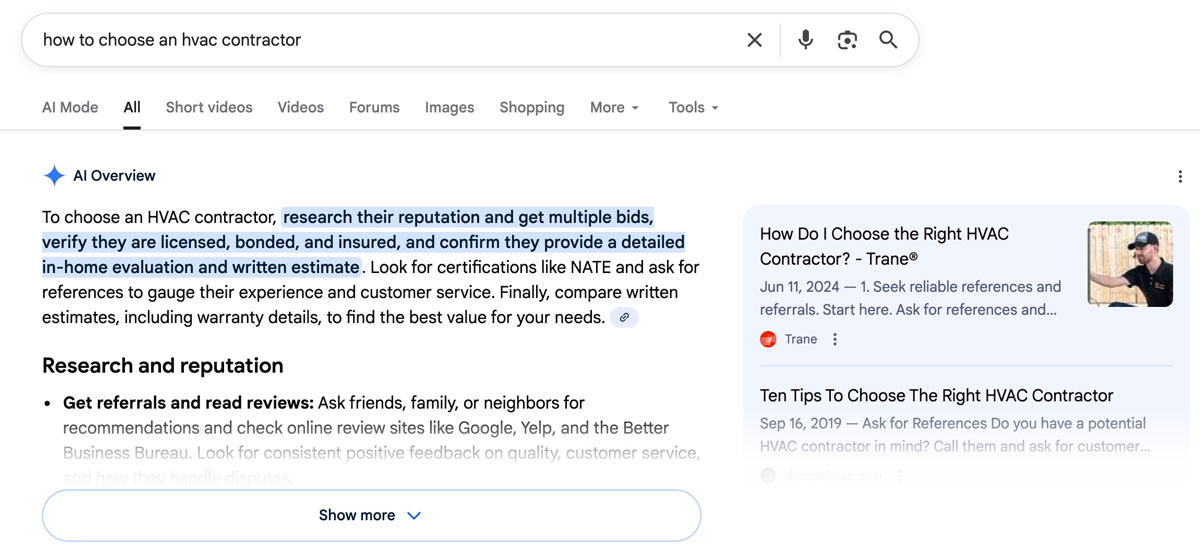
Google’s AI Overviews are expanding into local search queries. When users search for questions like “best roofing company near me” or “how to choose an HVAC contractor,” AI-generated summaries now appear at the top of results, synthesizing information from multiple sources. These AI Overviews provide instant answers to user queries, often reducing the need for users to click through to websites.
For local businesses, this creates both opportunity and challenge. Being cited in these AI Overviews provides massive visibility, but you’re competing against every authoritative source Google can find, not just local competitors. The businesses that create genuinely helpful, expert content optimized for AI understanding will dominate these placements.

Improved Local Intent Recognition
AI has dramatically improved Google’s ability to recognize local intent even without explicit location modifiers. Searches like “roofer” or “plumber” now automatically trigger local results when Google’s AI determines location matters to the query. The system understands context from your location, search history, and device to deliver hyper-relevant local options.
This means your local SEO strategy must account for both explicitly local searches (“plumber Pittsburgh”) and implicitly local ones (“plumber” searched from Pittsburgh). AI considers both when determining which businesses to show. Google Maps is a key tool for tracking local rankings, monitoring local search visibility, and understanding your business’s market positioning in real time.
Personalized Local Results
AI enables unprecedented personalization in local search results. Google’s algorithms consider your previous searches, locations you’ve visited, businesses you’ve interacted with, and even your demographic profile to customize which local businesses appear. Real time insights from AI tools help businesses adapt their strategies based on current search trends and user behavior.
Two people searching “HVAC repair” in the same neighborhood might see different businesses ranked differently based on AI’s prediction of which options best match their specific needs, preferences, and likelihood to convert. This personalization makes one-size-fits-all SEO strategies less effective.
Critical AI Ranking Factors You Must Optimize
Beyond the changes AI brings to search, specific ranking factors have become dramatically more important in 2025. Understanding and optimizing these factors determines whether you dominate or disappear from local search results.
Content Quality and Depth
AI systems can now accurately assess content quality in ways that weren’t possible before. Surface-level, thin content gets filtered out while comprehensive, expert content rises to the top. Key quality signals include:
- Comprehensive Topic Coverage: Address all aspects of a topic, not just surface details
- Original Insights: Provide unique perspectives, data, or expertise others don’t offer
- Practical Value: Include actionable advice, specific examples, and real-world applications
- Readability: Clear structure, appropriate reading level, and logical flow
- Multimedia Integration: Images, videos, and diagrams that enhance understanding
- Source Citations: Reference authoritative sources and data to support claims
- Regular Updates: Keep content current with the latest information and best practices
Technical SEO Foundation
AI can’t rank what it can’t properly crawl, understand, and process. Technical excellence has become non-negotiable:
- Core Web Vitals: Page load speed, interactivity, and visual stability
- Mobile Optimization: Responsive design that works flawlessly on all devices
- Structured Data: Schema markup that explicitly tells AI what your content covers
- Site Architecture: Logical structure with clear hierarchy and internal linking
- HTTPS Security: Secure connections are baseline requirements
- XML Sitemaps: Help AI discover and index all your important pages
- Crawlability: No technical barriers preventing AI from accessing content
Local Authority Signals
AI evaluates how deeply embedded you are in your local community and service area:
- NAP Consistency: Identical business information across all platforms
- Local Citations: Mentions in local directories, chambers of commerce, industry associations
- Local Backlinks: Links from other local businesses, news outlets, and community organizations
- Geographic Content Depth: Comprehensive coverage of neighborhoods, service areas, and local topics
- Community Involvement: Sponsorships, events, partnerships documented online
- Local Customer Base: Reviews and engagement from customers in your service area
- Service Area Specificity: Clear definition of exactly where you operate
Maintaining accurate directory listings and ensuring your business appears in relevant industry specific directories are essential for local SEO. These listings help AI and search engines verify your business information and improve your local search visibility.
Google Business Profile Optimization
Your GBP has become even more critical as AI relies heavily on this information:
- Complete Profile: Every section filled with accurate, detailed information
- Regular Posts: Consistent updates showing active management
- High-Quality Photos: Professional images of work, team, and facilities
- Review Volume and Velocity: Steady stream of new reviews
- Review Response Rate: Responding to all reviews, especially negative ones
- Q&A Section: Proactively answered common questions
- Attribute Accuracy: Correct business attributes and features
- Booking Integration: Direct appointment scheduling when applicable
User Experience Signals
AI tracks how users interact with your listing and website, using these signals to assess quality:
- Click-Through Rate: Percentage of people who see your listing and click
- Engagement Metrics: Time on site, pages per session, scroll depth
- Bounce Rate: Percentage of visitors who leave immediately
- Conversion Signals: Contact form submissions, phone calls, direction requests
- Return Visitors: People coming back to your site multiple times
- Navigation Patterns: How easily users find information
- Accessibility: Site usability for all users including those with disabilities
Service businesses now have access to AI-powered tools that were science fiction just a few years ago. These tools level the playing field, allowing small businesses to execute sophisticated strategies previously available only to enterprises.
AI Content Generation for Local Pages
Creating unique, valuable content for multiple service areas used to require significant time and resources. AI writing tools like ChatGPT, Jasper, and Claude can now generate location-specific content at scale while maintaining quality and uniqueness. Location pages play a crucial role in maintaining local search visibility, ensuring each service area is properly represented and optimized.
The key is using AI strategically. Generate first drafts of neighborhood pages, service descriptions, and blog posts, then add local expertise, specific examples, and authentic details. AI handles the heavy lifting of structure and initial content, while you provide the local knowledge that makes it genuinely valuable.
For a roofing company serving ten neighborhoods, AI can draft unique pages for each area incorporating local housing characteristics, climate considerations, and common issues. You then refine these with specific project examples, neighborhood photos, and detailed local insights.


AI-Powered Keyword Research
Modern AI tools analyze search patterns, user intent, and competitive landscapes to identify keyword opportunities traditional tools miss. These systems recognize semantic relationships between terms, predicting which keywords will drive actual business rather than just traffic.
Tools like SEMrush, Ahrefs, and SurferSEO use AI to understand which keywords your competitors rank for, which ones drive conversions versus just clicks, and which emerging searches present opportunities. This intelligence helps you focus efforts on keywords that actually grow your business.
AI also identifies long-tail, conversational keywords that match how people actually search. Instead of just “HVAC repair Pittsburgh,” AI tools surface phrases like “why is my furnace making clicking noises” or “how much does central air cost for 1500 square foot house.” These specific queries often convert better than generic terms.
Automated Review Management
AI-powered reputation management tools monitor reviews across all platforms, alert you to new feedback, and even draft personalized responses. Since reviews significantly impact local rankings and customer decisions, efficient review management is critical to boost rankings.
Tools like Podium, Birdeye, and Grade.us use AI to categorize reviews by sentiment, identify common themes in customer feedback, and suggest appropriate responses. Some can even detect fake reviews or spam that might harm your optimize your online presence.
The AI analyzes review patterns to identify operational issues before they become serious problems. If multiple customers mention slow response times or specific service issues, the system flags these patterns so you can address them proactively.
AI-Enhanced Local Listing Management
Managing business information across dozens of directories and platforms is tedious but essential for local SEO. AI-powered listing management tools automatically detect inconsistencies in your NAP (Name, Address, Phone) information and correct them across the web. For multi location businesses and multi location brands, maintaining consistent listings, reviews, and local search visibility across all sites is a major challenge. AI solutions help automate and scale these processes, ensuring accuracy and efficiency for businesses with multiple locations.
Services like Yext and BrightLocal use AI to monitor hundreds of directories, identify where your information appears incorrectly, and update listings automatically. This consistency is crucial because conflicting information confuses search engines and hurts your rankings.
Platforms such as Moz Local, Local Falcon, and other local SEO tools are also essential for managing and tracking local search rankings, monitoring competitor performance, and visualizing local search results across multiple locations and industries.
Predictive Analytics for Local SEO
AI analytics platforms now predict future trends based on historical data, helping you make proactive strategic decisions. These tools forecast seasonal search patterns, predict which service areas will generate the most demand, and identify optimal times to launch campaigns.
For service businesses with seasonal fluctuations, these predictions help you prepare content and campaigns before demand peaks. If AI predicts increased searches for “AC repair” starting in April, you can prepare and publish content in March to capture that traffic.
Optimizing Your Content for AI-Powered Local Search
Creating content that AI systems understand and favor requires specific approaches that differ from traditional SEO tactics.
Structure Content for AI Understanding
AI systems parse structured content far more effectively than dense paragraphs. Implement these formatting best practices:
- Clear Header Hierarchy: Use H2s for main sections, H3s for subsections, maintaining logical structure
- Short Paragraphs: Keep paragraphs to 2-4 sentences maximum for readability
- Bullet Points and Lists: Present information in scannable list formats when appropriate
- FAQ Sections: Include questions as headers with direct answers following
- Table of Contents: Add jump links for longer content pieces
- Bold Key Points: Emphasize important information without overusing bold text
- White Space: Adequate spacing between elements for visual clarity
- Logical Flow: Organize information in the order users would naturally seek it
Schema markup is critical for helping AI understand your content structure:
- Local Business Schema: Core information about your business
- Service Schema: Detailed markup for each service you offer
- FAQ Schema: Structured Q&A content
- Review Schema: Markup for customer reviews
- Article Schema: Blog post and content piece metadata
- Breadcrumb Schema: Site navigation structure
- Video Schema: Markup for video content
- How-To Schema: Step-by-step instructional content
Use schema markup to explicitly tell search engines what your content covers. Local Business schema, FAQ schema, and Service schema provide structured data that AI systems rely on to understand and categorize your content accurately.
Demonstrate Local Expertise and Authority
AI systems heavily weigh expertise signals when determining which content to feature and rank. For local businesses, establish authority through:
Credentials and Experience
- Years in business and company history
- Professional licenses and certifications
- Industry association memberships
- Awards and recognitions
- Insurance and bonding information
- Team member qualifications
Local Knowledge Depth
- Neighborhood-specific insights and content
- Local building codes and regulations
- Regional climate considerations
- Area housing characteristics
- Community involvement documentation
- Local project case studies
Content Expertise Signals
- Author bios with relevant credentials
- First-person experience and insights
- Original data or research
- Detailed technical explanations
- Problem-solving guidance
- Industry best practices
Include detailed “About” sections explaining your history in the community, certifications, years in business, and specific expertise. Add author bios to blog posts highlighting relevant credentials. Display licenses, insurance information, and professional association memberships.
Reference specific local projects, challenges unique to your area, and detailed knowledge of local regulations or requirements. This localized expertise signals to AI that you’re a legitimate local authority, not a generic content producer.
Create Comprehensive Topic Coverage
AI favors content that thoroughly covers topics rather than surface-level articles. Build topical authority through:
Pillar Content Strategy
A key part of an effective pillar content strategy for local businesses is thorough competitor research. Learn more in the Ultimate Guide to Local SEO Competitor Analysis.
- Comprehensive guides covering topics in depth (2,000+ words)
- Detailed exploration of all aspects and considerations
- Multiple examples and real-world applications
- Visual aids including images, diagrams, and videos
- Internal links to related detailed articles
Topic Clusters
Learn more about the latest local SEO insights and strategies on the Redshift Local Digital Marketing Blog.
- Core pillar page on main topic
- Supporting articles diving deep into specific aspects
- Clear internal linking between related content
- Logical content hierarchy and organization
- Coverage from beginner to advanced levels
Content Depth Indicators
- Word count appropriate to topic complexity
- Multiple subheadings breaking down the topic
- Examples from actual projects and experience
- Addressing common questions and objections
- Including next steps and related considerations
- Providing resources and additional information
Local content is particularly important for maintaining steady performance in local search, even as AI-driven search behavior evolves. Focusing on local content helps businesses remain resilient and visible despite changes in how users search.
When creating content about roof replacement, for example, address every aspect: types of materials, cost factors, timeline, preparation, choosing contractors, warranties, permits, and maintenance. Comprehensive coverage establishes topical authority, making AI more likely to cite your content in overviews and rank you higher for related searches.
Optimize for Conversational and Voice Search. For local businesses looking to drive engagement online, it’s also crucial to leverage effective email marketing strategies tailored to your audience.
As AI makes search more conversational and voice-activated queries increase, optimizing for natural language becomes essential. People speak differently than they type, using complete sentences and questions rather than keyword fragments.
Include content that answers questions people ask verbally: “How long does roof replacement take?” “What should I look for in an HVAC company?” “Why is my water heater making noise?” These conversational queries are precisely what AI systems are designed to answer.
Write in a natural, conversational tone rather than keyword-stuffed corporate speak. AI systems recognize and favor content that sounds like genuine expert advice rather than robotic marketing copy.
Leveraging AI for Google Business Profile Optimization
Your Google Business Profile remains central to local SEO, and AI tools can dramatically improve how you manage and optimize it.


AI-Generated GBP Posts
Regular GBP posts signal activity and expertise, but creating them consistently is time-consuming. AI writing tools can generate posts announcing recent projects, sharing seasonal tips, or highlighting services, which you then customize with specific details and photos.
Use AI to create posts optimized for different neighborhoods you serve. Generate templates mentioning specific areas, then personalize with local project photos and details. This consistent posting schedule, made manageable through AI assistance, keeps your profile active and engaging.
Intelligent Q&A Management
The Q&A section of your GBP influences both rankings and customer decisions, yet many businesses neglect it. AI tools can monitor this section, alert you to new questions, and suggest appropriate responses based on your service offerings. Proactively add common questions and optimized answers. Use AI to generate comprehensive responses to typical customer questions, ensuring your Q&A section provides valuable information while naturally incorporating relevant keywords.
Review Response Automation
Responding to every review individually is ideal but time-intensive. AI tools can draft personalized responses that acknowledge specific review details while maintaining your brand voice. You review and approve these responses, ensuring authenticity while saving substantial time.
The AI learns from your approved responses, improving its suggestions over time. It can identify which reviews require detailed personal responses versus which can use more standardized acknowledgments, prioritizing your attention appropriately. AI tools can also track and analyze customer interactions on your Google Business Profile, helping you enhance engagement and boost local search visibility.
Managing and responding to google reviews is a key factor in establishing trust and improving local SEO rankings. By leveraging AI for review management, you can strengthen your reputation and attract more local customers.
AI Agents and Local SEO
AI agents are rapidly becoming indispensable tools for local businesses aiming to boost their local SEO success. These advanced, AI-powered tools act as digital consultants, analyzing vast amounts of data to deliver personalized recommendations that help businesses improve their local search visibility and dominate local search results.
By leveraging AI agents, local businesses can streamline their local SEO strategy in several key ways:
- Automated Optimization: AI agents can automatically audit your website, Google Business Profiles, and online presence, identifying areas for improvement and suggesting actionable steps to enhance your local search rankings.
- Personalized Recommendations: Instead of generic advice, AI agents provide tailored strategies based on your specific business, industry, and competition, ensuring your local SEO efforts are both efficient and effective.
- Google Business Profile Management: AI agents can help optimize your Google Business Profiles by suggesting updates, identifying missing information, and even automating regular posts to keep your profile active and engaging.
- Reputation Management: These tools monitor online reviews across platforms, alert you to new feedback, and recommend the best ways to respond, helping you maintain a positive reputation and improve your standing in local search results.
- Competitive Edge: By continuously analyzing your competitors and the latest search trends, AI agents help you stay ahead of the curve, adapting your local SEO strategy to changes in the market and search engine algorithms.
The result is a more efficient, data-driven approach to local SEO that frees up your time while maximizing your local search visibility. Whether you’re a small business owner or managing multiple locations, AI agents empower you to make smarter decisions, automate routine tasks, and achieve local SEO success in an increasingly competitive landscape.
Local Search and Reputation Management in the Age of AI
In today’s digital landscape, reputation management is more critical than ever for local SEO. AI-powered tools are transforming how local businesses monitor, manage, and enhance their online reputation, directly impacting local search rankings and customer trust.
With AI-powered reputation management, businesses can:
- Monitor Reviews in Real Time: AI tools scan multiple review platforms, alerting you instantly to new customer feedback so you never miss an opportunity to engage.
- Automate Review Responses: AI can draft personalized, brand-appropriate responses to both positive and negative reviews, saving you time while ensuring every customer feels heard.
- Analyze Customer Feedback: Beyond just tracking star ratings, AI analyzes the sentiment and themes within reviews, providing actionable insights into what customers love and where improvements are needed.
- Drive More Positive Reviews: By identifying satisfied customers and prompting them to leave reviews, AI tools help you build a stronger online reputation, which in turn boosts your local search rankings.
- Maintain Accurate Online Presence: AI ensures your business information is consistent and up-to-date across all platforms, reinforcing your credibility and supporting your local SEO efforts.
By leveraging AI-powered tools for reputation management, local businesses can proactively shape their online image, respond quickly to customer concerns, and foster a steady stream of positive reviews. This not only enhances your reputation but also signals to search engines that your business is trustworthy and relevant, leading to improved local search visibility and higher local search rankings.
Local Listings, Citations, and AI-Driven Consistency
Accurate and consistent business listings across online directories are foundational to local SEO success. Inconsistent information can confuse both customers and search engines, leading to lower local search visibility and missed opportunities. AI-powered tools are revolutionizing how local businesses manage their local listings and citations, ensuring your business appears correctly in local search results every time.
Here’s how AI-driven consistency benefits your local SEO:
- Automated Listing Updates: AI tools can automatically update your business information—such as name, address, phone number, and hours—across hundreds of online directories, saving you time and reducing errors.
- Gap Analysis and Citation Opportunities: AI scans the web to identify missing or inconsistent citations, then suggests where to add or correct listings to strengthen your local presence.
- Targeting Local Keywords: AI-powered tools analyze your industry and location to recommend specific local keywords and phrases that will help your business rank higher for local intent searches.
- Improved Local Rankings: Consistent, accurate listings signal to search engines that your business is legitimate and trustworthy, directly improving your local rankings and local search visibility.
- Enhanced Online Engagement: When customers find accurate information about your business in search results and online directories, they’re more likely to visit, call, or engage with your business.
By leveraging AI-powered tools to manage your local listings and citations, you ensure your business information is always up-to-date and optimized for local search. This not only boosts your local SEO success but also drives more foot traffic and online engagement from customers searching for your services.
Voice Search and the Future of Local SEO
Voice search is rapidly changing the way customers find local businesses, and adapting your local SEO strategy to this trend is essential for staying visible in search engine results. With the rise of smart speakers, mobile assistants, and in-car voice search, more people are using natural, conversational language to find local services.
AI-powered tools are at the forefront of helping businesses optimize for voice search:
- Optimizing for Conversational Queries: AI analyzes how customers phrase local queries when speaking, helping you create relevant content that matches the intent and context of voice searches.
- Google Business Profile and Google Posts Optimization: AI can suggest updates and improvements to your Google Business Profile and Google Posts, ensuring your business profile provides accurate, helpful information that voice assistants can easily access and relay to users.
- Content Recommendations: AI-powered suggestions help you develop content that answers common voice search questions, such as “Where’s the best pizza near me?” or “What time does the hardware store close?” This increases your chances of being featured in voice search results.
- Understanding Search Behavior: AI tools track and analyze evolving search behavior, allowing you to adjust your local SEO strategy to capture more voice-driven traffic.
- Enhanced Local Search Visibility: By optimizing for voice search, your business is more likely to appear in the coveted “position zero” or featured snippets, as well as in local pack results, driving more conversions from customers searching hands-free.
To stay ahead, local businesses should embrace AI-powered tools that help them understand and adapt to the nuances of voice search. By focusing on natural language, optimizing your business profile, and providing relevant content, you’ll ensure your business remains visible and competitive as search behavior continues to evolve.
Understanding AI’s Impact on Local Search Behavior
AI isn’t just changing how search engines work but also how customers search for and evaluate local businesses.
Zero-Click Searches and AI Overviews
AI-generated answers increasingly satisfy user queries without requiring clicks to websites. When someone asks “average cost of roof replacement,” AI Overviews provide comprehensive answers directly in search results. This reduces traffic to individual websites but increases the value of being cited as a source.
Adapt your strategy by focusing on building authority and brand awareness through these citations while ensuring your GBP is optimized to capture customers when they’re ready to hire. Being mentioned in AI Overviews builds trust even if users don’t immediately click through.
Increased Expectations for Immediate Answers
AI-powered search has trained customers to expect instant, comprehensive answers. Your online presence must provide quick, clear information about services, pricing, availability, and processes. Vague or incomplete information causes potential customers to move to competitors who answer their questions immediately.
Implement AI chatbots on your website to provide instant responses to common questions. These tools handle initial inquiries 24/7, qualifying leads and scheduling appointments even when you’re unavailable. The immediate responsiveness meets customer expectations while capturing leads you’d otherwise lose.
Growing Importance of Conversation and Context
Search queries are becoming more conversational and context-dependent. Instead of “plumber Pittsburgh,” people search “why is my basement flooding and what should I do right now.” AI understands these complex, urgent queries and returns relevant local results.
Optimizing for local SEO helps businesses attract nearby customers by targeting location-specific keywords and improving visibility in local searches.
Create content addressing specific problems, emergencies, and decision-making processes customers face. Rather than just listing your services, explain how you solve specific problems, what to do in emergencies, and how to make informed decisions about hiring service providers.
Preparing Your Local Business for the AI-Powered Future
The transformation is accelerating, and businesses that prepare now will dominate their local markets while competitors scramble to catch up.
Invest in Quality Content and Expertise
AI amplifies the importance of genuine expertise and quality content. Low-quality, thin content that might have ranked through technical tricks now gets filtered out by sophisticated AI systems. Invest in creating truly valuable resources that demonstrate deep expertise.
Document your processes, share detailed case studies, explain complex topics in accessible ways, and provide insights only someone with genuine experience could offer. This authentic expertise becomes more valuable as AI gets better at distinguishing real knowledge from superficial content.
Build Comprehensive Local Authority
Establish yourself as the definitive local expert in your field by creating extensive content coverage of your service areas and specialties. AI systems recognize and reward comprehensive topical and geographic authority.
Create detailed pages for every neighborhood you serve, write about local regulations and requirements, discuss regional climate considerations, and share insights about local housing characteristics. This depth of local knowledge is difficult to fake and highly valued by AI systems.
Embrace AI Tools Strategically
The businesses that thrive will be those using AI tools to enhance rather than replace human expertise. Use AI for drafting content, analyzing data, managing routine tasks, and scaling efforts, but always add the human expertise, local knowledge, and authentic details that make content genuinely valuable.
Experiment with different AI tools to find which ones best fit your workflow and business model. Don’t adopt technology for its own sake, but strategically implement tools that solve real problems or create genuine competitive advantages.
Monitor and Adapt Continuously
AI technology and its impact on search evolve rapidly. What works today might be obsolete in six months. Establish processes for monitoring your local search performance, staying informed about AI developments, and adapting your strategy as the landscape changes.
Track which content gets featured in AI Overviews, which keywords drive qualified leads, how your rankings change, and what competitors are doing differently. Leverage AI-powered competitor analysis tools to gain competitor insights into other businesses’ local SEO strategies, rankings, and opportunities, enabling data-driven adjustments for better visibility and ranking improvements. Use these insights to refine your approach continuously rather than treating SEO as a set-it-and-forget-it tactic.


How Redshift Local Helps You Navigate AI-Powered Local SEO
At Redshift Local, we specialize in helping service businesses adapt to the rapidly changing local search landscape. We understand how AI is transforming local SEO and implement strategies that position our clients as dominant local authorities.
Our VTC Framework (Visibility, Traffic, Conversions) incorporates AI-optimized tactics throughout. We help you become visible in AI Overviews and traditional search results, drive qualified traffic from customers searching in AI-powered ways, and convert that traffic into booked jobs through optimized experiences.
We leverage AI tools to create scalable, high-quality content while ensuring every piece includes the local expertise and authentic details that make it genuinely valuable. We stay current with AI developments, testing new features and adjusting strategies as the landscape evolves so you don’t have to become an AI expert yourself.
Ready to ensure your business thrives in the AI-powered local search era? Contact Redshift Local today for a consultation on building a future-proof local SEO strategy.
Embrace AI or Get Left Behind
AI’s integration into local search isn’t coming. It’s here. The businesses succeeding in 2025 are those that have adapted their strategies to this new reality. Those still relying on tactics from 2020 are steadily losing visibility and market share.
The good news is that AI creates as many opportunities as challenges. Small service businesses can now implement sophisticated strategies, create content at scale, and provide customer experiences that previously required large teams and budgets. AI democratizes access to powerful marketing capabilities.
Start by understanding how AI is affecting your specific market and customer base. Implement the strategies outlined in this guide systematically, beginning with quick wins like optimizing your GBP and using AI tools for content creation. Build from there, continuously learning and adapting as AI capabilities expand.
The local businesses that dominate in the coming years will be those that embrace AI strategically, using it to amplify their genuine expertise and local knowledge. Don’t let the technology intimidate you. Instead, see it as a powerful tool that, when used properly, can transform your business growth and competitive position.
The future of local SEO is AI-powered, personalized, and conversational. Position your business to thrive in that future starting today.